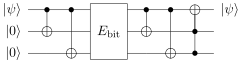
Researchers from the University of Wisconsin-Madison, the University of Arizona, and QEC Labs released QECLean, an open-source tool built on the Lean 4 proof assistant that uses software to mathematically prove the key properties of quantum error-correcting codes. Such codes protect quantum computers from errors, and the tool is aimed at checking complex codes that are hard to verify by brute force. The work was described in a technical preprint after a tutorial at IEEE Quant
Quantum computing companies are now using AI to design quantum error correction codes, which protect calculations from mistakes. Researchers say AI can test far more design options than people can by hand. Two examples were IBM's OpenEvolve and QC Design's Meridian.
IQM Quantum Computers unveiled an on-premises upgrade program for its Halocene quantum error-correction hardware at the SC26 conference in Chicago. It gives labs a path to move from a 150-qubit system to future machines with over 1,000 qubits without stopping their running work. IQM has not yet said when the 1,000-qubit systems will arrive.
Quantum Machines showed that its OPX1000 quantum control system can decode quantum error corrections in the middle of a quantum circuit. It used NVIDIA's CUDA-Q QEC decoding server and NVQLink on a GH200 server, with decoding under one microsecond per round for code distances 7 and 11. Early customer access is planned for December 2026.
Nvidia and IBM unveiled a new quantum error-correction algorithm and a joint research platform. Crypto circles are again debating the 'Q-Day' threat to Bitcoin's encryption. Experts say quantum computers are still far from being able to break Bitcoin.
IBM Research and AMD have released Pelagos, a free, open-source framework that uses graphics processing units (GPUs, chips built for fast parallel computing) to decode the error-correction data of quantum computers at very large scale. It is meant for testing a family of quantum error-correction codes called qLDPC at supercomputer size. The tool is available on PyPI, a public site for Python software.
Rigetti Computing, a maker of superconducting quantum computers, has added Quantum Elements' Constellation simulation environment to its quantum error correction work. The tool simulates chip behavior on classical computers to predict performance before running real hardware.
IBM, AMD, and the Oak Ridge National Laboratory (ORNL) in the United States have built a platform to jointly research technology that corrects errors in quantum computers. Quantum computers must reduce the small errors that occur during calculations before they can solve real problems. The platform links quantum computers with high-performance computers to test this technology.
IBM, AMD, and Oak Ridge National Laboratory have built a research environment that combines quantum computers with high-performance computers for quantum error correction. The goal is to strengthen technology that catches calculation mistakes in quantum computers and make practical quantum computers possible.
IBM, the Quantum Science Center at Oak Ridge National Laboratory in the US, and AMD have launched a new research platform that uses quantum computers and high-performance computers together. The goal is to scale up quantum error correction (a technology that fixes noise and errors that arise during calculations).