



កង់ទិច · អត្ថបទ
Researchers Release QECLean to Formally Verify Quantum Error-Correcting Codes
Quantum Computing Report ·
មើលត្រួសៗ
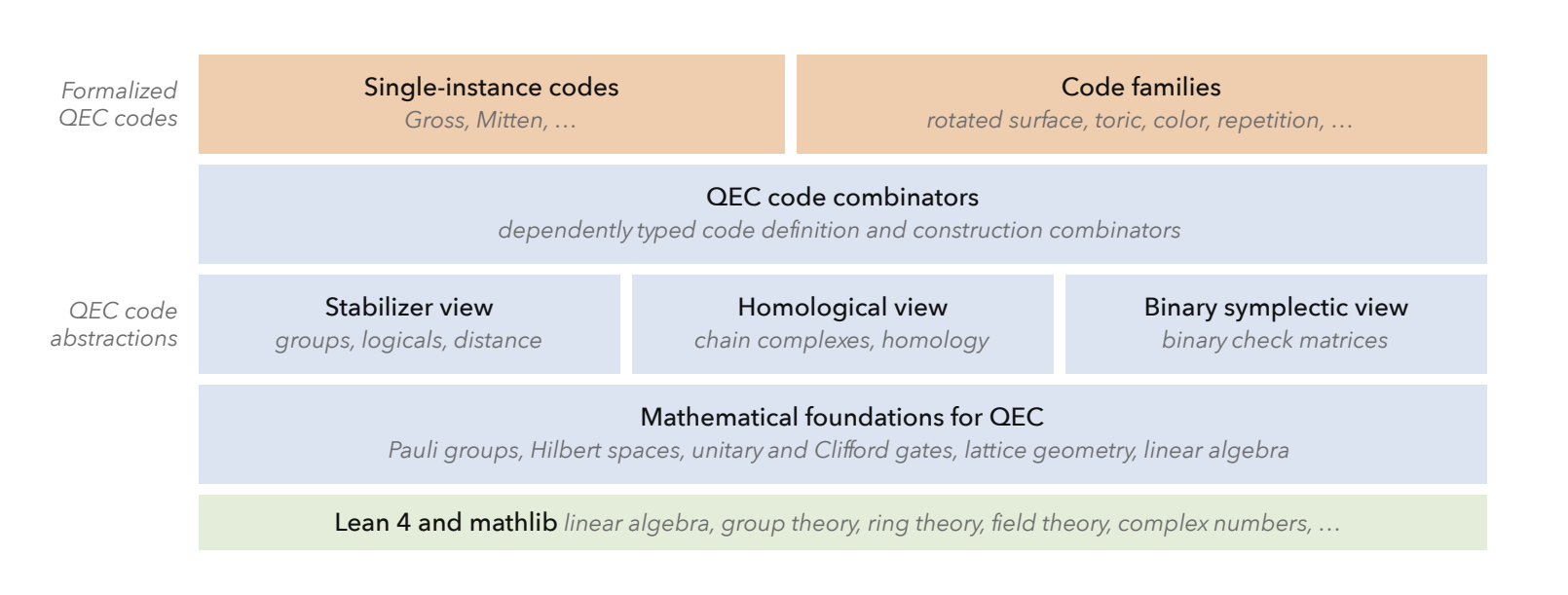
Researchers from the University of Wisconsin-Madison, the University of Arizona, and QEC Labs released QECLean, an open-source tool built on the Lean 4 proof assistant that uses software to mathematically prove the key properties of quantum error-correcting codes. Such codes protect quantum computers from errors, and the tool is aimed at checking complex codes that are hard to verify by brute force. The work was described in a technical preprint after a tutorial at IEEE Quant
ចំណុចសំខាន់ៗ
- QECLean is an open-source framework built on the Lean 4 proof assistant.
- It mathematically proves the parameters of quantum error-correcting codes.
- Standard solvers often stall on codes with distances above 18 and cannot prove results for infinite code families.
- The team added building-block tools to scale checks to large qLDPC (quantum low-density parity-check) codes.
ហេតុអ្វីវាសំខាន់
Quantum computers make many errors, so proven error-correcting codes are needed to trust them. Checking AI-discovered codes with formal proofs could make future quantum systems more reliable.
ប្រភពដើម
Researchers Introduce QECLean Framework to Formally Verify Quantum Error-Correcting Codes in Lean 4
Quantum Computing Report · Nov 20, 10:11 KST
Read on Quantum Computing Report ↗AI summarized the original article. Check the original for accuracy. Copyright belongs to Quantum Computing Report.
បន្ថែមពីវិស័យនេះ
- Yale Team Confirms Decade-Old Prediction on Fast-Moving Excitons in Thin Materials
Yale researchers have, for the first time, watched a type of energy-carrying particle called an exciton move in an unexpected way. The result backs a prediction made about ten years ago by Professor Diana Qiu. The team studied an atom-thin material.
Phys.org · Nov 21, 01:40 KST - Aalborg University Orders ConScience Quantum Computer for Engineering Training
Aalborg University in Denmark has chosen Swedish company ConScience to supply an on-site superconducting quantum computer for hands-on engineering training. It is set to be installed in 2027, starting with two qubits and growing to seven. Students will work directly with the hardware instead of only using cloud simulations or remote access.
Quantum Computing Report · Nov 21, 01:29 KST - France Backs €14M Qubit Control 2030 Project to Simplify Quantum Computer Wiring
France's National Quantum Strategy is putting €14 million (about $16 million) into a 48-month project called Qubit Control 2030. Led by the startup VIQTHOR, five French companies will build a domestic system to control quantum computers and cut down the bulky copper wiring that runs into the cold chamber. The project runs from October 2026 to September 2030.
Quantum Computing Report · Nov 21, 01:15 KST - Harvard Team Gets Diamond Quantum Spins to Move in Coordinated Spirals
Researchers led by Piotr Put at Harvard University made thousands of nitrogen-vacancy spins inside diamond act together at room temperature. The spins were randomly placed, yet they moved in a coordinated way. The result was published in Physical Review X.
Phys.org · Nov 20, 22:00 KST