



កង់ទិច · អត្ថបទ
IBM, Fermilab, NVIDIA Unveil Quantum Co-Design Platform and Slurm 26.11 Scheduling at SC26
Quantum Computing Report ·
មើលត្រួសៗ
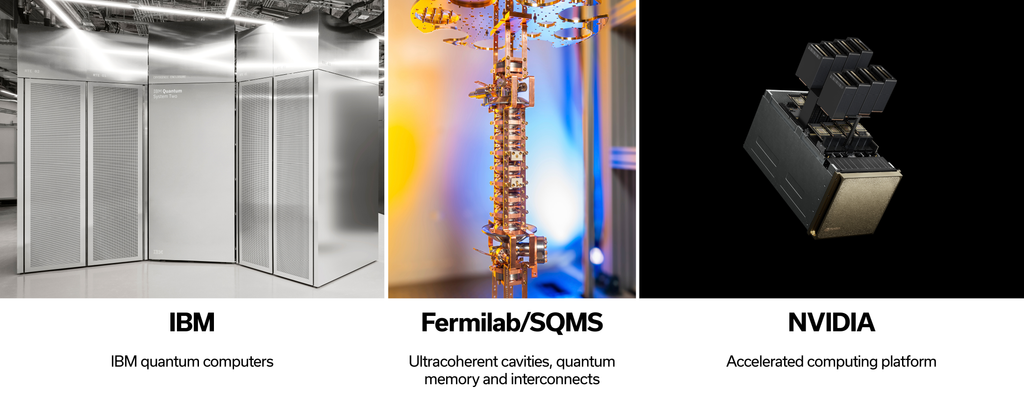
At the SC26 supercomputing conference in Chicago, IBM, NVIDIA, and Fermilab announced plans for a shared quantum-classical co-design platform. They also announced quantum scheduling in Slurm 26.11 and new GPU-based quantum error-correction software.
ចំណុចសំខាន់ៗ
- IBM, Fermilab, and NVIDIA plan to place NVIDIA DGX B200 systems next to IBM Quantum Nighthawk processors.
- The first phase will simulate communication links between quantum modules to measure how errors and delays affect results.
- A later phase plans to add Fermilab's superconducting cavity hardware as quantum memory.
- NVIDIA researchers described TCBP-JOBS, a decoding algorithm that runs on GPUs and keeps latency near milliseconds at moderate error rates.
ហេតុអ្វីវាសំខាន់
Quantum computers are hard to share and manage, and these tools aim to make them work with regular supercomputers. Such steps could bring quantum computing closer to practical research use.
ប្រភពដើម
IBM, Fermilab, and NVIDIA Unveil Modular Quantum Co-Design Platform, Slurm HRES Integration, and GPU QEC Tools at SC26
Quantum Computing Report · Nov 17, 04:25 KST
Read on Quantum Computing Report ↗AI summarized the original article. Check the original for accuracy. Copyright belongs to Quantum Computing Report.
ការផ្សាយផ្សេងទៀត
- The Quantum Insider · IBM, NVIDIA and Fermilab Plan Modular Quantum Computing Platform
- IBM Research 보도자료 · IBM, Fermilab, and NVIDIA Announce Plans for New Co-Design Platform to Accelerate the Development of Next-Generation, Modular Quantum Computers
- Unite.AI · NVIDIA, IBM, 페르미 연구소, 모듈형 양자 컴퓨팅 플랫폼 계획
- 솔루션뉴스 · 엔비디아, IBM·페르미랩과 양자컴퓨터 공동 설계
- 사이언스모니터 · 페르미랩·IBM·엔비디아, ‘모듈형 양자컴퓨터’ 공동설계 플랫폼 추진
- 양자신문 · IBM·페르미랩·NVIDIA, 모듈형 양자컴퓨팅 공동 설계 플랫폼 구축 추진
បន្ថែមពីវិស័យនេះ
- Yale Team Confirms Decade-Old Prediction on Fast-Moving Excitons in Thin Materials
Yale researchers have, for the first time, watched a type of energy-carrying particle called an exciton move in an unexpected way. The result backs a prediction made about ten years ago by Professor Diana Qiu. The team studied an atom-thin material.
Phys.org · Nov 21, 01:40 KST - Aalborg University Orders ConScience Quantum Computer for Engineering Training
Aalborg University in Denmark has chosen Swedish company ConScience to supply an on-site superconducting quantum computer for hands-on engineering training. It is set to be installed in 2027, starting with two qubits and growing to seven. Students will work directly with the hardware instead of only using cloud simulations or remote access.
Quantum Computing Report · Nov 21, 01:29 KST - France Backs €14M Qubit Control 2030 Project to Simplify Quantum Computer Wiring
France's National Quantum Strategy is putting €14 million (about $16 million) into a 48-month project called Qubit Control 2030. Led by the startup VIQTHOR, five French companies will build a domestic system to control quantum computers and cut down the bulky copper wiring that runs into the cold chamber. The project runs from October 2026 to September 2030.
Quantum Computing Report · Nov 21, 01:15 KST - Harvard Team Gets Diamond Quantum Spins to Move in Coordinated Spirals
Researchers led by Piotr Put at Harvard University made thousands of nitrogen-vacancy spins inside diamond act together at room temperature. The spins were randomly placed, yet they moved in a coordinated way. The result was published in Physical Review X.
Phys.org · Nov 20, 22:00 KST