

Quantum · Article
IBM, Fermilab, NVIDIA Unveil Quantum Co-Design Platform and Slurm 26.11 Scheduling at SC26
Quantum Computing Report ·
At a glance
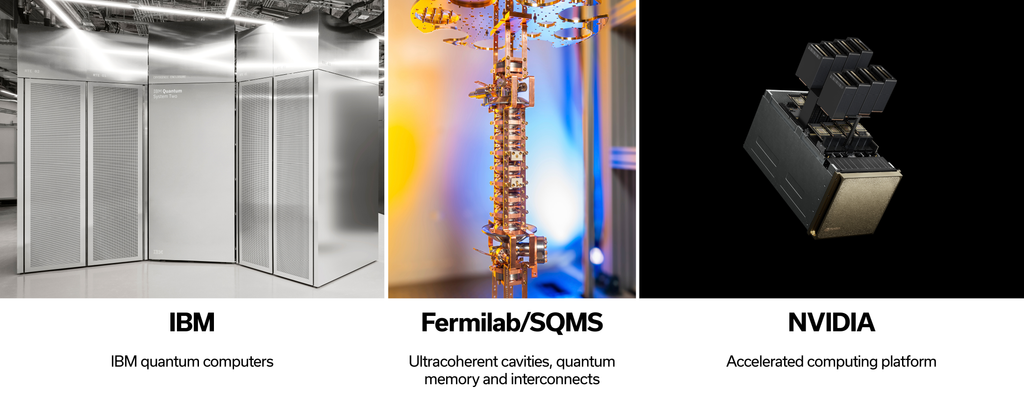
At the SC26 supercomputing conference in Chicago, IBM, NVIDIA, and Fermilab announced plans for a shared quantum-classical co-design platform. They also announced quantum scheduling in Slurm 26.11 and new GPU-based quantum error-correction software.
Key points
- IBM, Fermilab, and NVIDIA plan to place NVIDIA DGX B200 systems next to IBM Quantum Nighthawk processors.
- The first phase will simulate communication links between quantum modules to measure how errors and delays affect results.
- A later phase plans to add Fermilab's superconducting cavity hardware as quantum memory.
- NVIDIA researchers described TCBP-JOBS, a decoding algorithm that runs on GPUs and keeps latency near milliseconds at moderate error rates.
Why it matters
Quantum computers are hard to share and manage, and these tools aim to make them work with regular supercomputers. Such steps could bring quantum computing closer to practical research use.
Original source
IBM, Fermilab, and NVIDIA Unveil Modular Quantum Co-Design Platform, Slurm HRES Integration, and GPU QEC Tools at SC26
Quantum Computing Report · Nov 17, 04:25 KST
Read on Quantum Computing Report ↗AI summarized the original article. Check the original for accuracy. Copyright belongs to Quantum Computing Report.
Other coverage
More from this field
- NEC and IBM Japan Test Hybrid Quantum Key and Post-Quantum Encryption Setup
NEC and IBM Japan tested a setup that combines quantum key distribution (QKD, a way to share encryption keys using quantum physics) with post-quantum cryptography (encryption designed to resist future quantum computers). Both key sources were run in parallel inside one proxy, which is a relay placed in front of existing communication systems. The test ran from July to September 2026 and did not require changes to existing company applications.
Quantum Computing Report · Nov 17, 10:22 KST - OIST Builds Ultracold Diamond Maser That Boosts Quantum Signals 1,000-Fold
Researchers at the Okinawa Institute of Science and Technology (OIST) built a spin-based microwave amplifier that works near absolute zero. It boosts weak signals more than 1,000 times while adding almost the least possible noise. The team says it could help quantum computers and sensors.
Phys.org · Nov 17, 07:40 KST - Quantum Spin Linked to Heat-Carrying Vibrations in Ultrathin Semiconductor
Researchers at UCLA and Auburn University measured atomic vibrations that carry heat and sound in an ultrathin semiconductor and linked them to electron spin. The link was strongest when the material was cooled and its spins organized into a zigzag pattern. The work could help future low-energy, low-heat computing devices.
Phys.org · Nov 17, 06:40 KST - Infleqtion Posts Q3 2026 Revenue of $9.1M and Reaches 30-Logical-Qubit Milestone
Infleqtion, a quantum computing and sensing company listed on the NYSE, reported third-quarter 2026 revenue of $9.1 million, up 25% from a year earlier. It also kept its 2026 revenue outlook of at least $45.1 million. The company said it reached a milestone of 30 logical qubits (error-corrected qubits used for reliable calculation).
Infleqtion 보도자료 · Nov 17, 06:05 KST