



AI · Article
OpenAI Releases BioBasicsBench to Test How Well AI Agents Interpret Lab Data
Unite.AI ·
At a glance
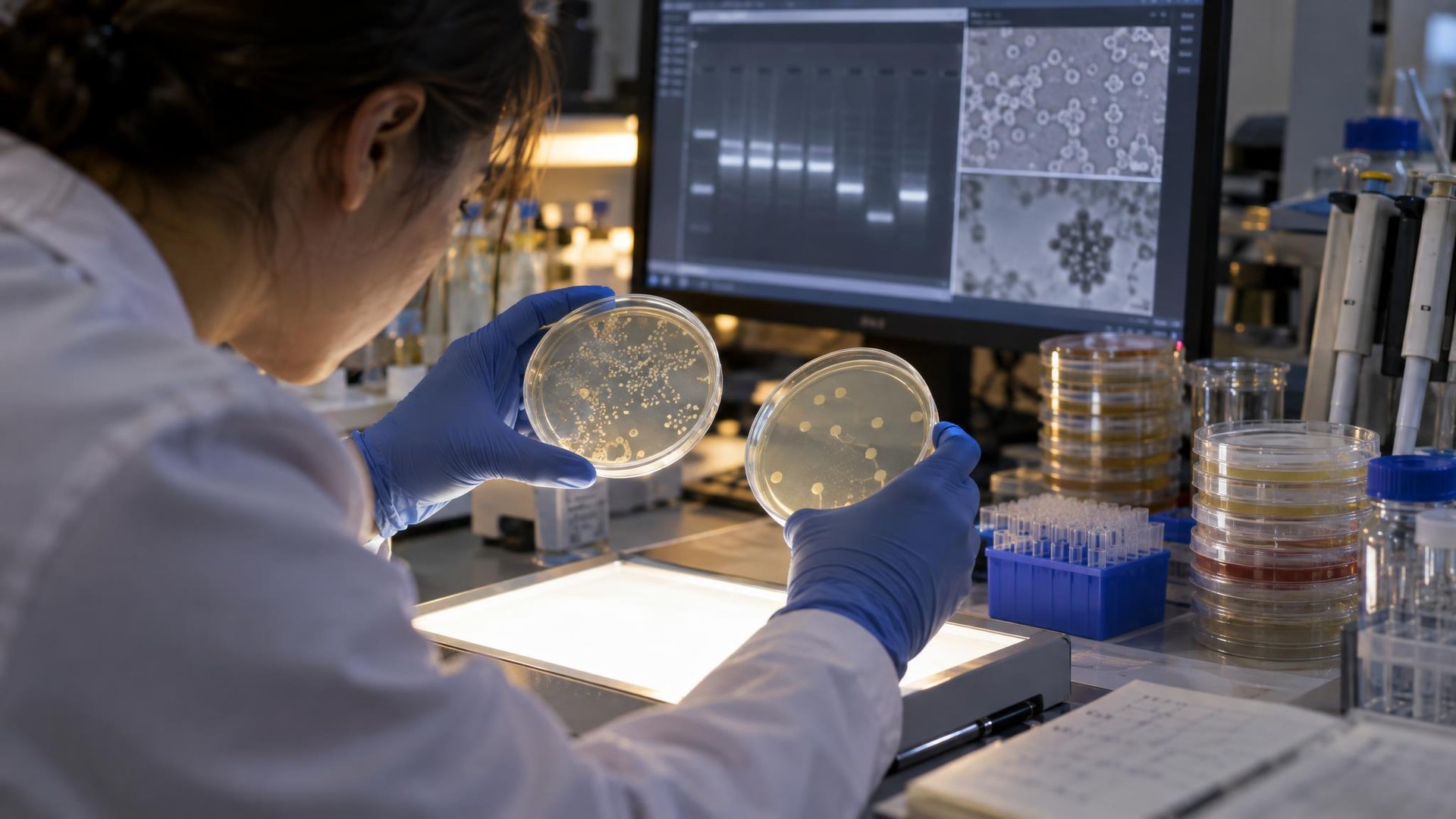
OpenAI has released BioBasicsBench, a benchmark that tests whether AI agents correctly interpret raw data obtained in laboratories. It consists of 100 tasks created with Ligo, an enzyme design company. The top-performing model scored 66.7%.
Key points
- The tasks are built from data taken from real experiments, such as gel images, cell microscope photos, and colony culture dishes.
- In some tasks, the AI noticed errors in the control group (the baseline experimental condition) and withheld its conclusions.
- However, there were also mistakes, such as counting about 12% more colonies than the reference in colony counting, or choosing the wrong lane.
- OpenAI warned that a higher score does not mean the results can be fully trusted in a lab.
Why it matters
If AI misreads experimental results, it could lead to using the wrong samples or drawing wrong conclusions, so benchmarks that check how reliable AI is in real labs are important.
Original source
OpenAI, AI 에이전트의 습식 실험실 데이터 해석 능력을 평가하는 BioBasicsBench 공개
Unite.AI · Nov 7, 07:18 KST
Read on Unite.AI ↗AI summarized the original article. Check the original for accuracy. Copyright belongs to Unite.AI.
OpenAI · Ranking and more news
More from this field
- AWS Adds Shared Cache Skill to Cut Self-Hosted LLM Cost and Latency
AWS wrote about a shared cache that lets self-hosted AI models reuse saved work across servers, aiming to cut cost and wait time. The post shows how a coding agent can help set it up. Amazon says it can cut inference cost by up to 40% and first-token delay by up to 80%.
Amazon AWS Machine Learning blog · Nov 21, 09:14 KST - Can AI Really Find Black Friday TV Deals? A BBC Test Says Not Yet
A BBC team tested four popular AI chatbots to see if they could find a good Black Friday deal on a 55-inch TV. The results were mixed, with many links broken or out of date.
BBC News · Nov 21, 09:06 KST - Anthropic Mathematician Says Claude Helped Crack the Riemann Hypothesis
A video about a claim that an Anthropic mathematician, Levent Alpöge, used Claude to find a proof of the Riemann Hypothesis in about six weeks. The creator skips the heavy math and looks at what this could mean for AI and its future. The proof is still being checked.
TheAIGRID · Nov 21, 08:45 KST - Google Brings Duplex Calling to Gemini, Letting AI Phone Businesses for You
Google has moved its Duplex phone-calling technology into the Gemini app, so Gemini can now call businesses for you. The system has changed a lot since 2018, shifting from narrow custom models to a single stack built on Gemini.
Google Research blog · Nov 21, 08:30 KST