

Quantum · Article
Quandela and NVIDIA Set Benchmark for When Photonic Quantum Computers Beat GPUs
Quantum Computing Report ·
At a glance
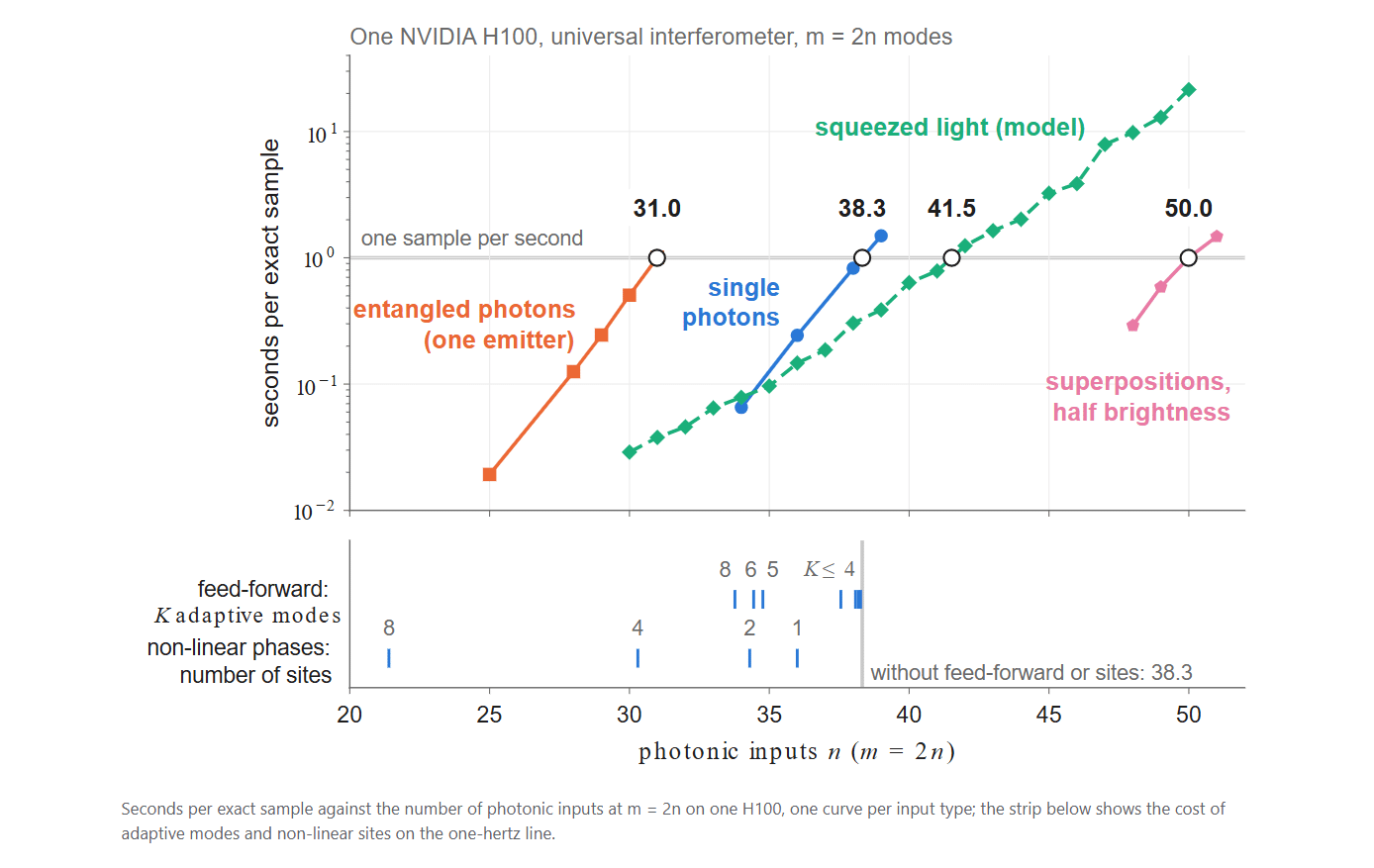
Researchers from Quandela, CNRS, and NVIDIA published a benchmark that sets a standard way to measure when photonic quantum processors (quantum computers that use particles of light) beat exact classical simulation on one NVIDIA H100 GPU. The study uses an open-source GPU library called photonic-engines and a technical preprint, which is an early version of a research paper.
Key points
- The team defined a "simulability frontier", meaning the point where a quantum processor becomes faster than the best classical method, using one throughput measure instead of earlier thresholds that ranged from 50 to 98
- Exact classical simulation gets exponentially harder as photon counts grow, so adding more GPUs gives only small gains; about 10^16 GPUs would be needed for 100 single-photon inputs without better algorithms.
- A new algorithm and custom CUDA code (software for running tasks on NVIDIA GPUs) raised the single-photon frontier from 32.5 to 38.3 inputs on the same hardware.
- A realistic photonic processor could produce small samples that are easy to simulate, but reproducing its continuous output in real time would need about 30 H100 GPUs, and energy estimates suggest a possible advantage be
Why it matters
It gives a common yardstick for judging when quantum light-based computers truly outperform classical computers, which helps readers separate real progress from hype.
Original source
Quandela and NVIDIA Benchmark Photonic Quantum Simulability Frontiers on H100 GPUs
Quantum Computing Report · Nov 19, 02:04 KST
Read on Quantum Computing Report ↗AI summarized the original article. Check the original for accuracy. Copyright belongs to Quantum Computing Report.
More from this field
- Qatar and France Sign Digital Cooperation Pact Naming Quantum as Shared Goal
Qatar and France signed a letter of intent to work together on artificial intelligence, digital technology, and emerging technologies, naming quantum technology as a shared priority. The signing took place in Doha during an International Telecommunication Union conference. The framework sets out ways to share technical know-how and build digital skills, but it has no disclosed project funding.
Quantum Computing Report · Nov 19, 02:39 KST - Quandela Signs Qatar Deployment Deal and Taiwan Foundry Pact for Photonic Quantum
French photonic quantum computing company Quandela signed two international deals on November 12 and 13, 2026. One is a partnership in Qatar to deploy its quantum systems across Gulf countries. The other is a memorandum of understanding with Taiwan's Hermes-Epitek to jointly build photonic quantum hardware.
Quantum Computing Report · Nov 19, 02:00 KST - Alice & Bob Doubles 2030 Target to 200 Logical Qubits with Modular Cat-Qubit Roadmap
Alice & Bob, a quantum computing company based in Paris and Boston, has updated its plan for building fault-tolerant quantum hardware. It now aims for 200 logical qubits (error-corrected qubits) by 2030, double its earlier target, and 2,048 by 2034. The 2030 system, called Carbon, would use 3,600 physical cat qubits, a type of superconducting qubit that naturally resists one kind of error.
Quantum Computing Report · Nov 19, 01:36 KST - Quantum Physics Can Verify a Person's Location, NIST Researchers Show
Researchers at NIST and partners ran the first experiment showing that quantum physics can confirm where a person is. The test used two stations 195 meters apart and entangled photons, which are particles of light linked so that measuring one reveals the other. The team closed loopholes that had left earlier quantum verification methods open to fraud.
Phys.org · Nov 19, 01:00 KST