



AI · ផ្លូវការ
Google Labs Launches Tabletop, a Shared Workspace for Group Planning
Google Labs blog ·
មើលត្រួសៗ
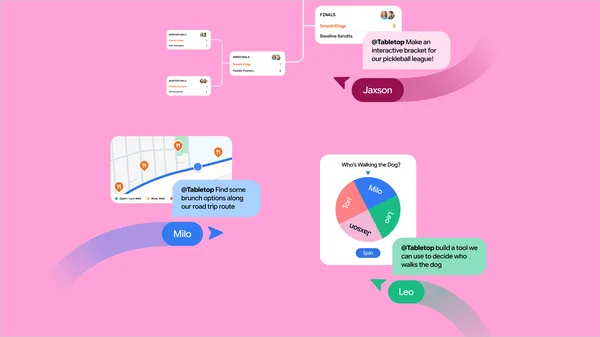
Google Labs has released Tabletop, a new experimental space where groups can plan and decide together in real time. Users can use AI (artificial intelligence) to create trip itineraries, dinner polls, expense splitters, and tournament brackets.
ចំណុចសំខាន់ៗ
- Add links, files, and ideas, then type @tabletop to generate a custom interactive space.
- You can also start from a ready-made template.
- Share the invite link in a group chat so everyone can edit at the same time, like a Google Doc.
- It is rolling out in the U.S. to people 18 and older through a waitlist.
ហេតុអ្វីវាសំខាន់
It makes it easier to handle group decisions like trips and club activities in one place, which is a change useful in everyday life.
ប្រភពដើម
Try Tabletop: Customizable, collaborative spaces for groups to plan, play and do more together.
Google Labs blog · Nov 12, 01:00 KST
Read on Google Labs blog ↗AI summarized the original article. Check the original for accuracy. Copyright belongs to Google Labs blog.
ការផ្សាយផ្សេងទៀត
បន្ថែមពីវិស័យនេះ
- Amazon SageMaker HyperPod Global Inference Gateway Routes AI Requests Across Regions
Amazon SageMaker HyperPod now has a Global Inference Gateway that sends each request to the best cluster across regions through one endpoint. Before this, clients had to choose a cluster themselves, and a busy cluster could leave requests waiting while idle GPUs sat elsewhere.
Amazon AWS Machine Learning blog · Nov 21, 07:35 KST - Google Drops Search Button and Adds AI Sidebar to Its Search Homepage
Google has officially rolled out a redesigned desktop search homepage after a successful test. The Google Search button next to the search bar is gone, and a row of AI buttons now sits under the bar. Logged-in users also get a sidebar showing their recent AI Mode conversations.
Ars Technica · Nov 21, 06:58 KST - Meta Rethinks 2030 Net-Zero Goal as AI Data Center Emissions Hit Record High
Meta's 2026 sustainability report said the company is re-evaluating its 2030 net-zero goal. Its emissions rose about 40 percent from 2024 to 2025, the largest jump among the big US tech companies.
Ars Technica · Nov 21, 06:47 KST - Anthropic Mathematician Says Claude Helped Crack the Riemann Hypothesis
Levent Alpöge, a mathematician at Anthropic, says he has proved the Riemann hypothesis with help from Claude, Anthropic's AI system. Instead of a regular math paper, he posted a four-page note and linked to computer code that he says checks the result. The claim still needs to be verified.
The New York Times · Nov 21, 06:47 KST