



កង់ទិច · អត្ថបទ
Qedma, IBM, RIKEN and BlueQubit Track Long-Lived Quantum Oscillations on 74 Qubits
Quantum Computing Report ·
មើលត្រួសៗ
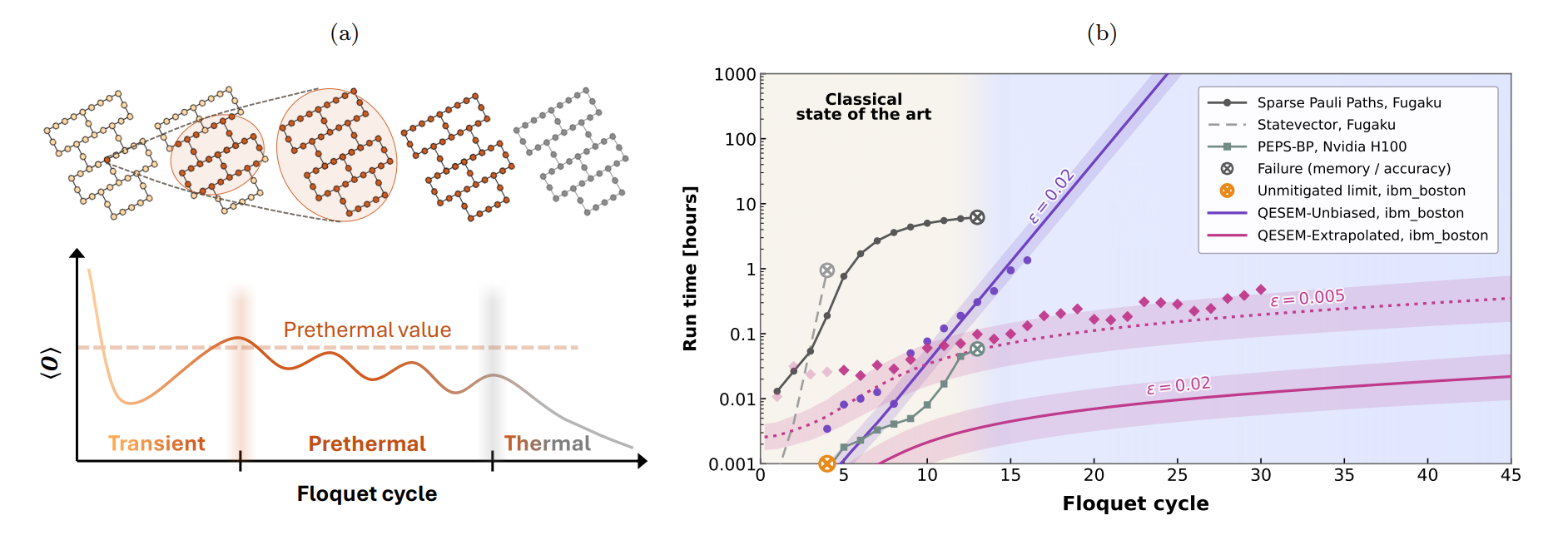
Researchers from Qedma, IBM, RIKEN, and BlueQubit ran a quantum experiment on up to 74 qubits, the units of quantum computing. They tracked long-lived magnetization oscillations in a driven magnet model, a regime where leading classical simulation methods failed to converge. Most runs used IBM's 156-qubit Heron r3 processor with Qedma's error-mitigation software, and results were cross-checked on Quantinuum's trapped-ion machines.
ចំណុចសំខាន់ៗ
- The team studied a repeating pattern in a magnet model on grids of up to 74 qubits.
- The signal stayed measurable for 30 cycles, while raw hardware results turned to noise by cycle 4.
- Error-mitigation software (methods that correct hardware noise) recovered results that matched small exact benchmarks.
- Classical tensor-network and Pauli-path simulations drifted or dropped key effects at these sizes.
ហេតុអ្វីវាសំខាន់
It shows quantum hardware with error correction can produce results that classical computers struggle to reproduce at this scale.
ប្រភពដើម
Qedma, IBM, RIKEN, and BlueQubit Resolve Prethermal Floquet Dynamics on 74 Qubits Beyond Classical Convergence Limits
Quantum Computing Report · Nov 29, 11:21 KST
Read on Quantum Computing Report ↗AI summarized the original article. Check the original for accuracy. Copyright belongs to Quantum Computing Report.
បន្ថែមពីវិស័យនេះ
- Quantum Speed-Up for Neural Network Training Holds Only at Huge Scales
Researchers from Fraunhofer IKS, the Technical University of Munich, and Ludwig-Maximilian University checked whether quantum linear-system solvers could speed up training large neural networks. They found that the quantum core helps only at small sizes. Once state preparation, reading out results, and classical gradient work are included, the advantage only appears at enormous scales.
Quantum Computing Report · Nov 29, 11:47 KST - Waterloo Delivers Quantum Light Sources to Canada's Space Agency for QEYSSat
The University of Waterloo's Institute for Quantum Computing delivered two ground-based quantum light sources to the Canadian Space Agency for the QEYSSat satellite mission. The sources will send encrypted optical signals from Earth up to the satellite.
Quantum Computing Report · Nov 29, 11:41 KST - Naval Research Lab and BlueQubit Test Quantum Method for Fluid Flow Equations on IBM Chips
Researchers from the U.S. Naval Research Laboratory and BlueQubit built a quantum computing method for solving a nonlinear fluid-flow equation (Burgers' equation). They tested it on BlueQubit's GPU simulator and on several IBM quantum chips. The method needs only one helper qubit (the basic unit of quantum information) and stays efficient as problems grow.
Quantum Computing Report · Nov 29, 11:31 KST - Trapped-Ion Quantum Hardware Probes Holographic Wormhole and Backreaction Signatures
Researchers from Duke, Virginia Tech, the University of Maryland, BlueQubit, IonQ, and Caltech ran holographic quantum error-correcting codes on IonQ's Forte trapped-ion quantum computer. They saw entropy patterns that resemble gravity's effect on space and wormhole-like connections. The work suggests quantum hardware can serve as a small testbed for theories about how spacetime emerges.
Quantum Computing Report · Nov 29, 11:07 KST