

Quantum · Official
Google's Willow Chip Wins Quantum Magic Square Game 98.3% of Rounds
Google Research blog ·
At a glance
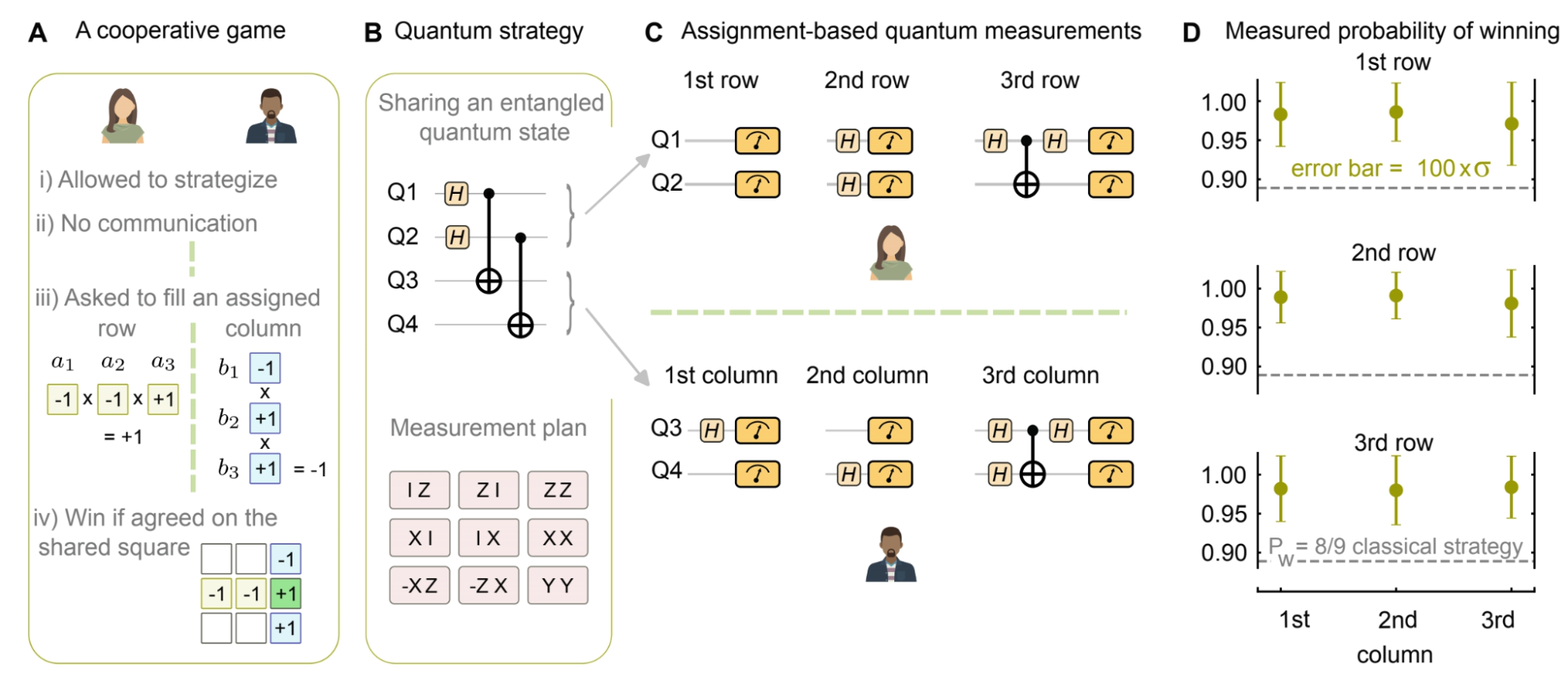
Google Quantum AI ran a 'magic square' game on its Willow superconducting processor and won 98.3% of rounds. Classical strategies cannot win every round, so the result shows a quantum advantage. Google also tested the idea on tasks using up to 105 qubits.
Key points
- The magic square game is a puzzle where two players must fill a grid without talking, and quantum tricks let them win every round.
- Any strategy without quantum effects can win at most 88.89% of rounds.
- Google's Willow chip won 98.3% of rounds, beating the classical limit.
- The team also tested tasks using up to 105 qubits, and these tests can detect hardware errors that random-circuit tests miss.
Why it matters
It shows that quantum computers can do things classical computers cannot, and it gives a new way to test quantum hardware.
Original source
A game you cannot win unless you have a quantum computer
Google Research blog · Nov 20, 05:03 KST
Read on Google Research blog ↗AI summarized the original article. Check the original for accuracy. Copyright belongs to Google Research blog.
More from this field
- Silicon Quantum Computing CEO Explains Atom-Based Qubit Approach
Physics World's podcast features Michelle Simmons, founder and CEO of Silicon Quantum Computing, an Australian company. The company builds quantum processors that use single phosphorus atoms inside silicon as qubits. In the interview she explains how these qubits are controlled and read out.
Physics World · Nov 19, 23:00 KST - IonQ Tops 11 Quantum Firms in Q3 Earnings Ranking Despite Weak Stock Prices
Analyst Gaeul Bada compares the Q3 earnings of 11 quantum computing companies and ranks them. IonQ comes out on top, with its quarterly revenue about 3.5 times that of the other ten combined. The article also explains why the stock prices of several smaller firms fell after results.
네이버 프리미엄콘텐츠 · Nov 19, 09:05 KST - Synchronized Atoms Create New Laser-Like Frequency Comb That Flashes in Rhythm
Researchers at Caltech and Stanford found that billions of atoms in a crystal can synchronize and flash light in a steady rhythm, forming a new kind of frequency comb. The atoms emitted microwaves and infrared light together, a combination not seen before. The team says this could lead to more stable lasers and help link quantum devices.
Phys.org · Nov 19, 09:00 KST - Paderborn's Photonic Quantum Computer Reveals Key Factors Behind Its Performance
Researchers at Paderborn University in Germany used their Paderborn Quantum Sampler, a photonic quantum computer, to study which quantum resources matter most for its performance. The team built a programmable machine from scalable parts and new analysis methods. The results were published in the journal PRX Quantum.
Phys.org · Nov 19, 07:10 KST